
Return of The Tern
Elegant, swirling, twisting, twirling, breathtaking, hovering, dipping, and fluttering are some of the words I use to describe them. When I hear the first call or see one fly by in May, I sigh with relief. No longer do I need to hold my breath, wait, wonder, or worry, about how many, if any, will arrive. It’s the return of the terns, black terns of course, and another joyous nesting season at Missisquoi NWR.
What makes black terns special? With population declines of more than 50% since 1966, black terns are sparce and uncommon, especially in the northeast, and one of Vermont’s state-endangered species. In the world of terns, they are somewhat of an anomaly. If you think terns are sleek, white, plunge-diving birds, that nest on beaches…then think again!
Instead of having light (mostly white) breeding plumage like other terns, black terns prefer to breed incognito, with black heads and underparts, and dark gray wings and backs. You won’t find them sprawling on beaches. Instead, black terns sequester themselves in secluded freshwater wetlands and build sparse floating nests among vegetation, for protection from wind, waves, and disturbance. In lieu of the flashy, splashy, plunge-diving antics of other terns, black terns opt for a no-nonsense feeding style; they simply skim the water for fish or hawk insects from the air, while flying.
For four months (May-August) each year, black terns live as little-known, striking black-and-gray marsh birds, breeding in North America’s freshwater wetlands. But that’s not their whole story. Near the end of the breeding season, black terns molt the black feathers on their heads and underparts to a more ternlike winter white. A change in disguise seems fitting since black terns lead a double life! Once they leave the breeding grounds, black terns do the unthinkable; they migrate to the coasts of Central and South America to spend the winter as beach bums!
Since 2004, Missisquoi National Wildlife Refuge is the only place where black terns nest in Vermont. The number of breeding pairs on the refuge (2009-2021) has varied throughout the years, with a high of 166 pairs in 2017 to a low of 57 pairs in 2020. Sadly, since 2022, the number of breeding pairs has declined, ranging from 29 breeding pairs in 2022, to 54 breeding pairs in both 2024 and 2025. This decline isn’t happening only at Missisquoi NWR; breeding pair numbers are plummeting throughout the United States and Canada.
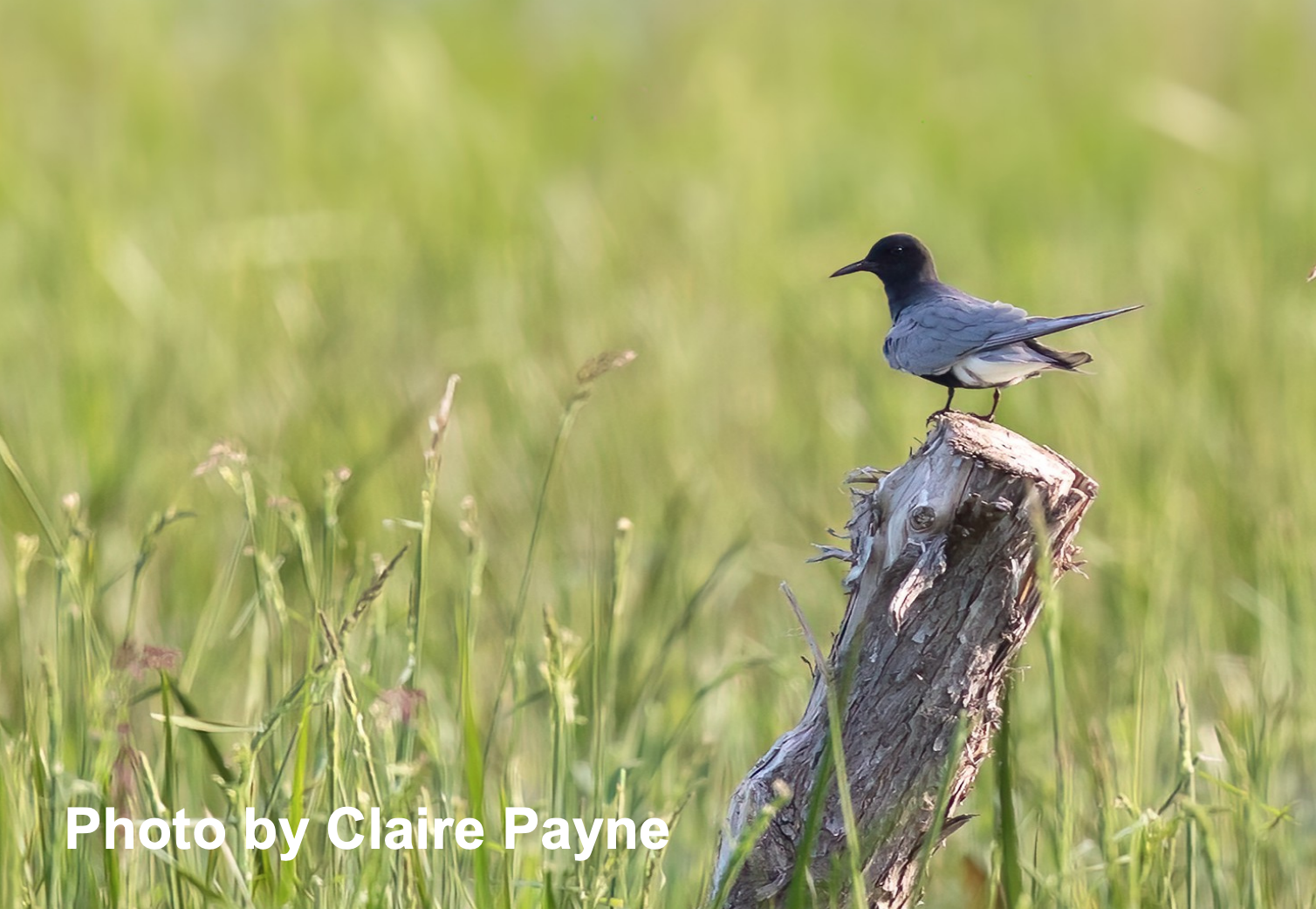
Previously, black tern conservation efforts focused solely on maintaining and restoring breeding habitat for future generations. Recent research, however, has broken that egg wide open! Realizing that full life-cycle management (including migration, stopover sites, and wintering areas) is needed to ensure the black tern’s survival, researchers now are working to uncover the most perilous parts of their journey, and to pinpoint the most effective conservation actions.
Black terns, once found breeding in small wetlands across the landscape, now nest in a few large wetland complexes, found almost exclusively on publicly managed lands. The vast, unique, and undisturbed wetlands of Missisquoi are why they’re still here. I can’t express how much they mean to me, or what a privilege it’s been, to watch these birds, up close and personal, at Missisquoi NWR.
by Judy Sefchick, Wildlife Biologist, Missisquoi NWR
The pictures accompanying this story were generously shared by Ed Kanze, an Adirondacks naturalist, guide, and photographer. You can see more of his incredible photography at https://www.edkanze.com/news. Explore his website at https://www.edkanze.com/