
When Hogs Swim
It’s another beautiful summer day on the Missisquoi River. Boating along, we notice a furry creature in the water. Thinking it’s a beaver or muskrat, we move closer to get a better look, but…it isn’t! Much to our surprise, it’s a groundhog (a.k.a. woodchuck), slowly dog-paddling along, determined to make its way to the riverbank on the opposite side.
Closely related to squirrels, woodchucks have many nicknames as well as abilities. It may surprise you to know that these hole-digging, vegetable-gobbling bandits can live up to six years in the wild. Their longevity is no surprise; these ‘land beavers’ seldom stray far from their burrows, and quickly retreat into them when danger approaches. Having eyes, ears, and nose at the top of its head, a groundhog can stealthily check its surroundings by barely poking its face out of the ground. In addition, ‘whistle pigs’ can climb nottoo-tall trees and swim, though neither are its forte. If there is one take-away for groundhogs, it’s do not underestimate them! When threatened, these lumbering marmots can run at speeds of 10 mph--the same as an Asian elephant!
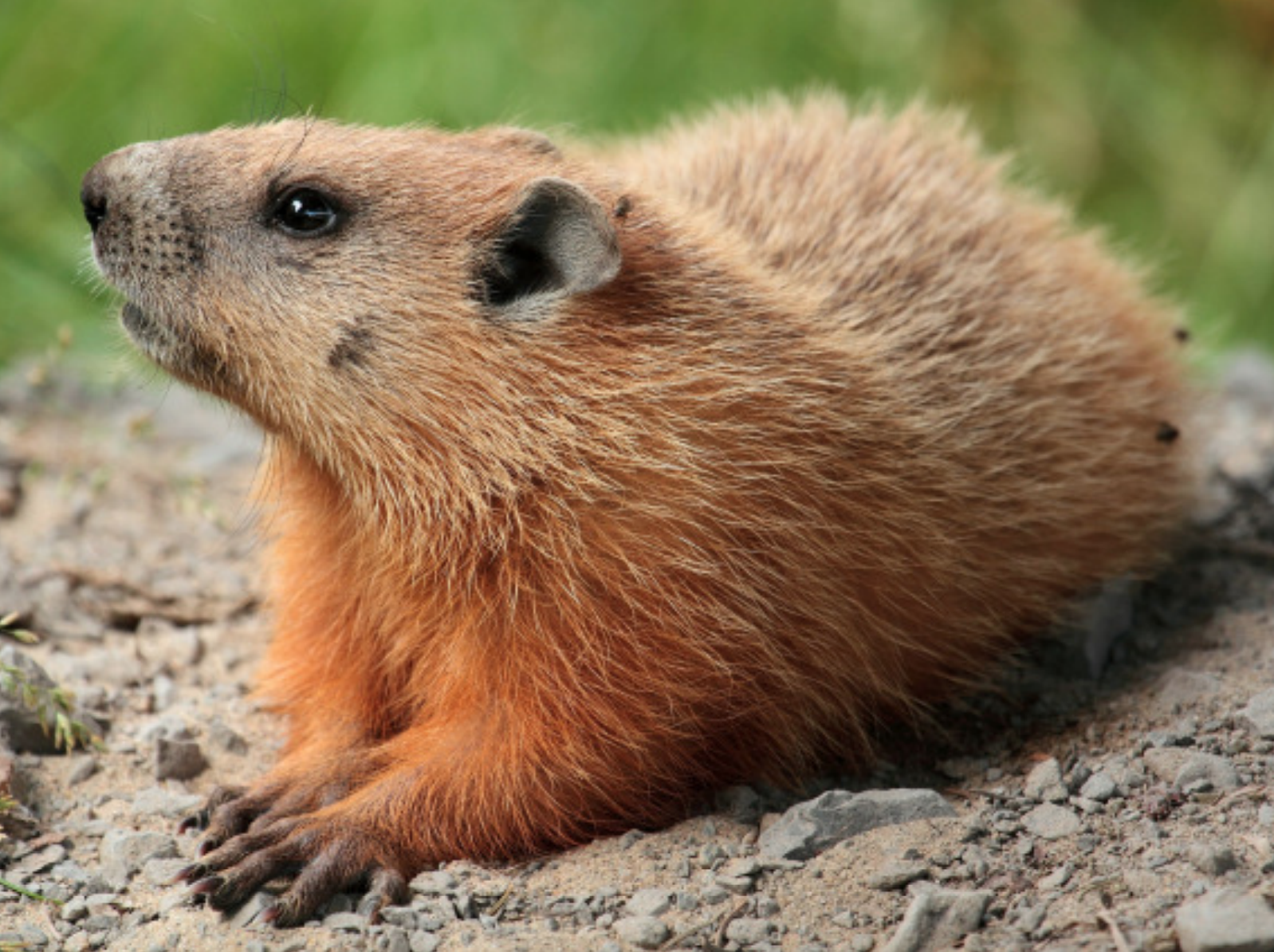
If you’ve wondered ‘how much wood could a woodchuck chuck if a woodchuck could chuck wood,’ the answer is simple: woodchucks don’t chuck wood, but they sure can chuck dirt! According to a wildlife biologist at New York’s Cornell University, woodchucks can move about 700 pounds of dirt when digging their burrows. Adept architects with strong, clawed forelimbs and large teeth, the ‘thick wood badger’ can easily construct burrows extending 5 feet underground, containing 45 feet of tunnels, and having as many as five entrances! What’s more, each burrow features a main entrance, one or more spy holes, a toilet chamber, and sleeping quarters!
During the fall of the year, groundhogs do little else except eat. Losing about half of their body weight during winter hibernation, they need a thick layer of fat for survival. Chomping as much as 1-1/2 pounds of grasses, leaves, clover, and herbs in a day ensures they have one. Amazing for an animal that weighs between 5 and 10 pounds!
What goes on in a woodchuck burrow during winter? Not much, since they are true hibernators! During this time, they hole up in a side chamber of their burrow, slow their heartbeat (from more than 100 beats per minute to as few as 15), drop their body temperature (from about 90o F to about 40o F), and decrease their respiration. If they arouse, it’s only for a moment before they settle back down into deep slumber. Though they don’t look the part, roly -poly groundhogs become wintertime yoga masters of a sort; they spend the 6 or 7 months (usually October to April) of hibernation curled up in a ball, with their heads tucked between their hind legs! Don’t try this at home folks.
Fortunately, this story has a happy ending. The groundhog we observed did get to the other side of the Missisquoi River. It climbed ashore as if it were nothing, hesitated for only a moment, and then ambled away onto bigger and better things. What motivated the woodchuck to do this? We’ll never know for sure. The only certainty about this unexpected spectacle is that it probably wasn’t the first time this hog-of-the-ground went for a swim!
by Judy Sefchick, Wildlife Biologist, Missisquoi NWR